Teamsters Political Action in Minnesota: History, Structure, and Influence
Teamsters have played a significant and enduring role in Minnesota’s political landscape. From early labor struggles in Minneapolis to modern political action committees and advocacy efforts, Teamsters Local 320 political engagement in Minnesota reflects both a deep historical legacy and an evolving approach to public policy and electoral politics.
2026 Legislative Priorities
Teamsters Local 320 is focused on one mission: ensuring that the voices of working members are heard clearly at the Minnesota State Capitol. This year’s legislative priorities reflect the real concerns members raise and the union’s commitment to turning those concerns into action.
Member Voices Driving Change
What sets Local 320’s legislative priorities apart is its foundation in member experience. These priorities are not abstract policy goals; they come directly from conversations on the shop floor, in break rooms, and in the field. By organizing, advocating, and engaging in the political process, Teamsters Local 320 members are ensuring that lawmakers understand the real-world impact of their decisions.
The 2026 legislative session presents both challenges and opportunities. Teamsters Local 320 stands ready to work with lawmakers from both parties to advance policies that strengthen workers, families, and communities across Minnesota. With a clear agenda and a united membership, Local 320 will continue bringing the voices of working people from the shop floor to the Capitol, where they belong.
Robust Wages & Benefits
Demand sustainable wages and comprehensive benefits for workers
Local 320 will be seeking a Public Defender wage increase. The MN Board of Public Defense and Local 320 is seeking a 3.25% increase.
Provide for first wage increase since August 2023: Cost of living adjustments of 1.5% in FY 2026 and 1.75% in FY 2027, and step increases.
Maintain salary parity with prosecutors- enable the recruitment and retention of quality staff.
$6,900,000 in FY 2026 and $13,700,000 in FY 2027
Increased enforcement for wage theft.
Modeled after the Massachusetts Wage Act, this proposal would require employers to pay all earned wages on time and in full, prohibit retaliation and misclassification, and allow workers to sue for unpaid wages. Violations would result in mandatory damages, attorney’s fees, and potential personal liability for company officials, with enforcement authority granted to the state.
Probation officer and 911 telecommunicator pension benefit, a self-funded plan to be put in place that would lock in, among other things, a 60-year old retirement threshold for probation officers and 911 telecommunicators.
Legislative Commission on Pensions and Retirement is introducing legislation to create benefit and retirement age changes.
Probation Officers and 911 Telecommunicators Pension Plans Work Group completed its work earlier this fall. LCPR staff submitted the Work Group’s report to the Commission in February.
The report recommends the establishment of a new PERA-administered pension plan for probation officers and 911 telecommunicators who are local government employees, and a new subplan within the MSRS General Plan for probation officers and 911 telecommunicators who are state employees.
Local 320 is working now to get a handle on healthcare costs for our members. Ever rising healthcare costs and prescription medication costs are eating away at Local 320 members’ and their family household budgets.
Our goal is to procure the most cost-effective health and drug benefits with the best provider network for Local 320 members. The State Employee Group Insurance Program (SEGIP) member health benefits (medical and pharmacy) are a critical cost driver for our members. Based on a 4 year old contract and steeply rising prescription medication costs, we are demanding that the next pharmacy benefit procurement happen immediately.
Local 320 is focused on the next pharmacy benefit procurement and the attempt by MMB to eliminate the reverse auction and seek legislative changes.
Working with the union and healthcare coalition to improve nursing home employee minimum wage standards.
Protect the gains made over the past several years to unemployment and health insurance for hourly school workers.
Strengthen Minnesota Labor Laws
Modernize and reform the Minnesota Public Employment Labor Relations Act (PELRA) labor organizing laws
Local 320 prioritizes overhauling and reforming the statutory definition of “Employee Organization” to strengthen employees’ rights to organize and affiliate, ensuring that union representation is available to the broadest number of employees organized at each job site.
Specifically, Local 320 seeks to modernize and clarify the ability for multiple affiliated unions to organize certain categories of employees within an employer organization.
Fund long overdue Minnesota State and the other public facilities project
A robust bonding bill strengthens Minnesota’s infrastructure, economy, and communities while responsibly leveraging the state’s strong credit rating — making it one of the most effective bipartisan investments the Minnesota Legislature can support.
The last State Bonding bill was passed in 2023. There is a backlog of projects that must be completed around the state to invest in our future:
Local 320 is advocating for higher education infrastructure facility funding of projects at Minnesota State Universities.
Roads and bridges
Water and sewer infrastructure
Flood control
State buildings
Dams, levees, and flood mitigation systems
We support a robust bonding bill because it’s pro-jobs, pro-infrastructure, pro-community investment, and is fiscally pragmatic.
Establish Equal Rights for Workers
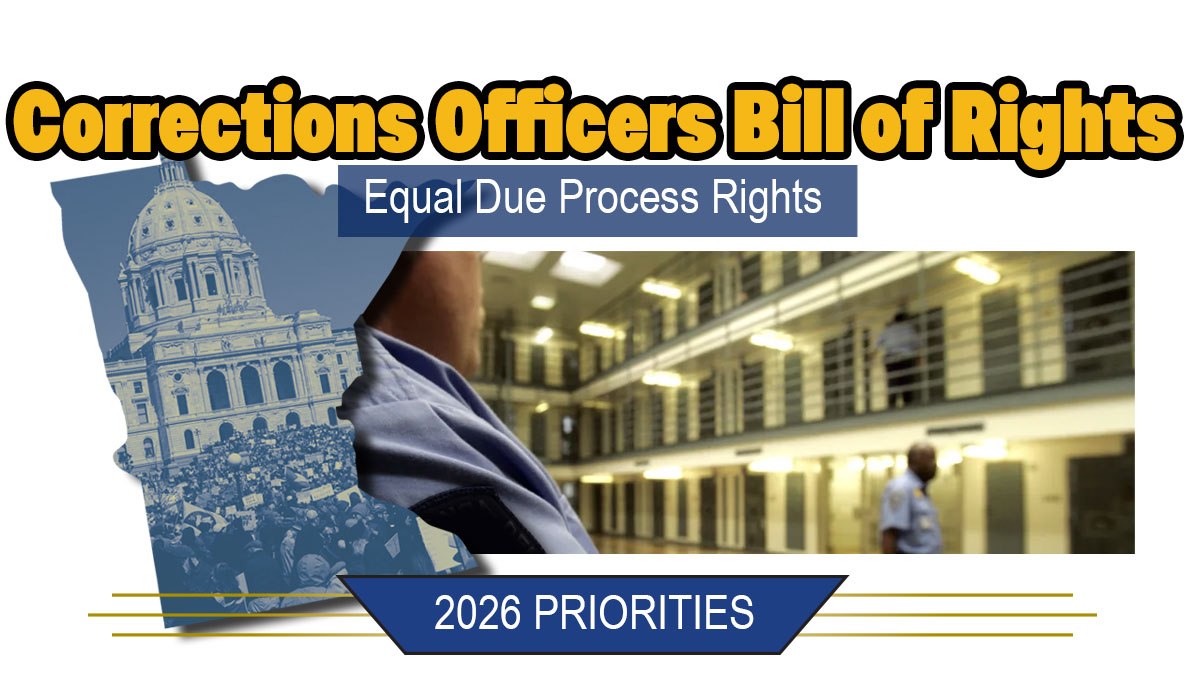
Advancing due process parity for corrections officers
The Legislation improves due process rights for Local 320 corrections officer members by amending the MN Correctional Officer Discipline
Procedures Act.
Corrections Bill of Rights: Minnesota statute would provide correction officers under investigation the same due process rights that a peace officer in Minnesota is guaranteed.
HF1410/SF2422 – passed in the 2025 MN House, but will need to be amended in the Senate with the agreed upon legislative bill language.